
Stop further payments and approvals, secure any account access you exposed, and contact the company used to pay. Preserve the seller, transaction, and message evidence. Ask about available remedies promptly, but do not trust anyone promising guaranteed recovery for an upfront fee.
U.S. FTC — what to do if you were scammed.
Separate the exposures before choosing a remedy
List what happened: money sent, card details entered, password disclosed, login approved, gift-card PIN revealed, identity document uploaded, or software installed. Several can occur in one incident and require parallel attention.
A payment dispute will not necessarily secure a compromised TikTok account. Changing the TikTok password will not recover a gift-card code already redeemed. Match each exposure to the party or control that can address it.
Use a trusted device and independently reached support when you suspect the device or session is affected. Avoid continuing sensitive actions inside the flow the seller provided, even if the page now claims to offer help.
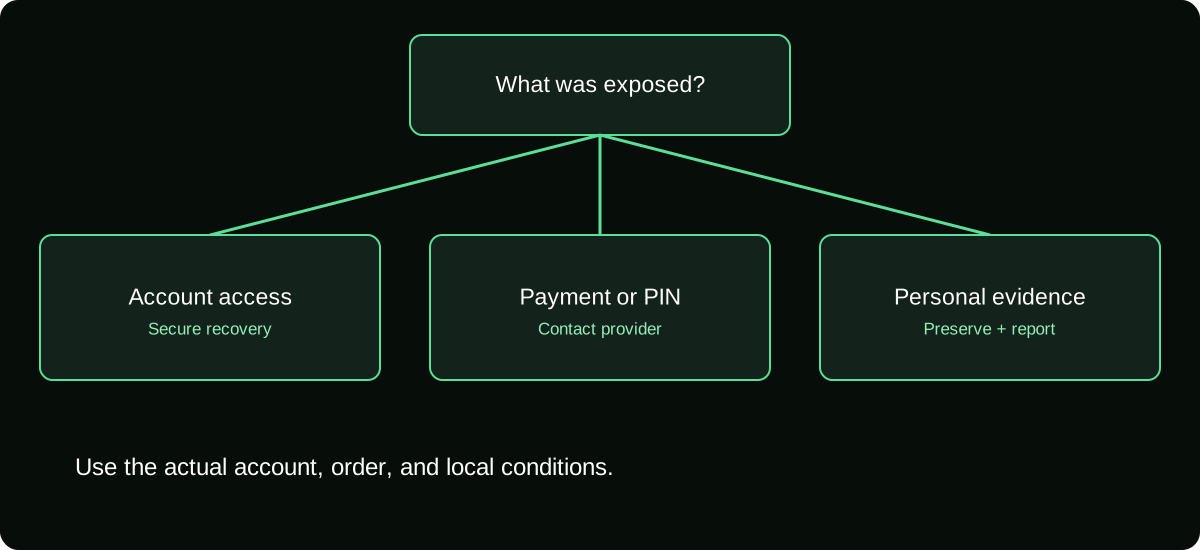
Stop the next transaction first
Do not pay a verification deposit, release tax, shipping charge for a digital product, or refund-processing fee to the same counterparty. A new payment does not become safe because it is described as recovering the first one.
Cancel an unapproved authorization through the legitimate control when possible, and inspect the status of actions already submitted. Do not assume closing a tab reverses a completed payment.
If a bank, wallet, or store account may still be exposed, contact that provider through its official app or independently sourced contact information. Describe what was disclosed and ask what protective steps are available for the actual account.
Secure account access and recovery routes
If you shared a password or approved a login, use TikTok's legitimate security settings and recovery process. Review devices, linked contact information, and sensitive account changes. Check payout settings if you are a creator.
Secure the email or other account that can reset access. Reusing the same password elsewhere can broaden the incident, so identify affected credentials rather than treating TikTok in isolation.
TikTok's Security Checkup covers recovery contacts, two-step verification, devices, alerts, and passkeys where supported. Use those controls from your own profile, not through a message from someone claiming to be the recovery agent assigned to you.
Contact the payment company with accurate facts
| How you paid | Useful first contact |
|---|---|
| Credit or debit card | Issuer or bank through its official channel |
| Payment app or wallet | Provider's actual transaction-support process |
| Bank or wire transfer | Sending bank or transfer company |
| Gift-card code | Card issuer or relevant seller with the original receipt |
| Crypto payment | Service used to send, where relevant, plus appropriate reporting |
The U.S. FTC advises contacting the company used to send money and asking whether a reversal or refund is possible. Its guidance also makes clear that recovery can be difficult and is not guaranteed. Readers elsewhere should use the provider and consumer or law-enforcement routes appropriate to their location.
Tell the truth about the payment. If you authorized it because of deception, explain that. Do not invent an unauthorized-card claim or conceal an existing merchant refund.
Build a concise evidence file
Save the seller's identifiers, actual web address, product description, messages, promised delivery, payment reference, amount, currency, date, and outcome. Retain original gift-card or order documents when relevant.
Create a short timeline rather than forwarding an unstructured collection of screenshots. Identify the promise, the action you took, the failure, and any further demand. This helps the provider match the evidence to its process.
Redact unrelated private information when sharing a copy. Keep an original securely if needed for a legitimate investigation. Do not post complete receipts, identity documents, card details, or PINs in public comments hoping someone will solve the case faster.
Report the right transaction to the right party
If you paid an outside seller, do not automatically describe the merchant charge as a direct TikTok purchase. The payment reference identifies the actual counterparty and determines which dispute process may apply.
Report impersonation, malicious messages, or account abuse to TikTok through its legitimate tools. Separately report the payment issue to the provider. For a genuine official Coin order that was not delivered, retain the merchant receipt and use the appropriate purchase-support route instead of assuming every delay proves a scam.
In the United States, the FTC provides ReportFraud as a reporting route. Other countries have their own consumer, cybercrime, or police processes. Reporting helps document the incident but should not be represented as a guarantee that funds will be returned.
Reject follow-up recovery scams
After a public complaint, another account may claim it can trace Coins, reverse transfers, or recover a hacked profile for a fee. It may quote your case details to seem legitimate.
The FTC specifically warns about refund and recovery scams that demand payment or sensitive information. Do not let the urgency of the first loss make the second claim appear exempt from verification.
Reach the actual provider independently and use its case number. A private person's claim to know staff, use special recovery software, or guarantee a payout does not establish authority over your transaction or account.
Track the outcome without deleting the history
Record case references, submission dates, requests for evidence, and final decisions. A case opened, refund approved, and money received are different stages. Keep both the original loss and any recovery so your records remain accurate.
If the provider declines, preserve the reason and ask about legitimate review options where offered. Do not pay a stranger to override the decision. If money arrives later, update any related cases so the same loss is not reimbursed twice.
Once the urgent work is complete, identify the control that failed: copied domain, private login request, unverified card seller, or pressure to pay quickly. Strengthen that specific step. The practical aim is to stop additional exposure, give legitimate investigators usable evidence, and avoid another loss disguised as the solution.
Frequently asked questions
Should I delete all messages immediately?
Preserve relevant evidence first when it is safe to do so, then use blocking and reporting controls appropriately. Losing the seller and transaction details can make a legitimate case harder to investigate.
Can I promise the payment provider that no Coins arrived if I cannot access the account?
State exactly what you know and what you cannot verify. An inaccessible account is evidence of an access problem, not automatic proof of every delivery outcome.
What if I am embarrassed to report it?
Give the provider a factual timeline. Scams rely on deception and urgency; withholding relevant information because of embarrassment can make the practical response harder.
Sources and scope
- U.S. FTC — what to do if you were scammed
- U.S. FTC — refund and recovery scams
- TikTok Newsroom — Security Checkup controls