
Verify the exact product and purchase destination before paying a TikTok Coin seller. Use official recharge or a verifiable supported gift-card route where available. Reject requests for account credentials, unexpected login approvals, or private fees to activate or release Coins.
TikTok Virtual Items Policy — rest-of-world scope stated on the page.
Identify what the seller is offering
There is a meaningful difference between official Coin checkout, a gift card supported under specific terms, and a stranger promising to manipulate a balance. Do not evaluate them as if they were the same product sold through different websites.
Ask for the product name, issuing terms, eligible region, delivery mechanism, and merchant identity before providing payment information. A vague promise of “recharge service” is not enough to determine what you are buying.
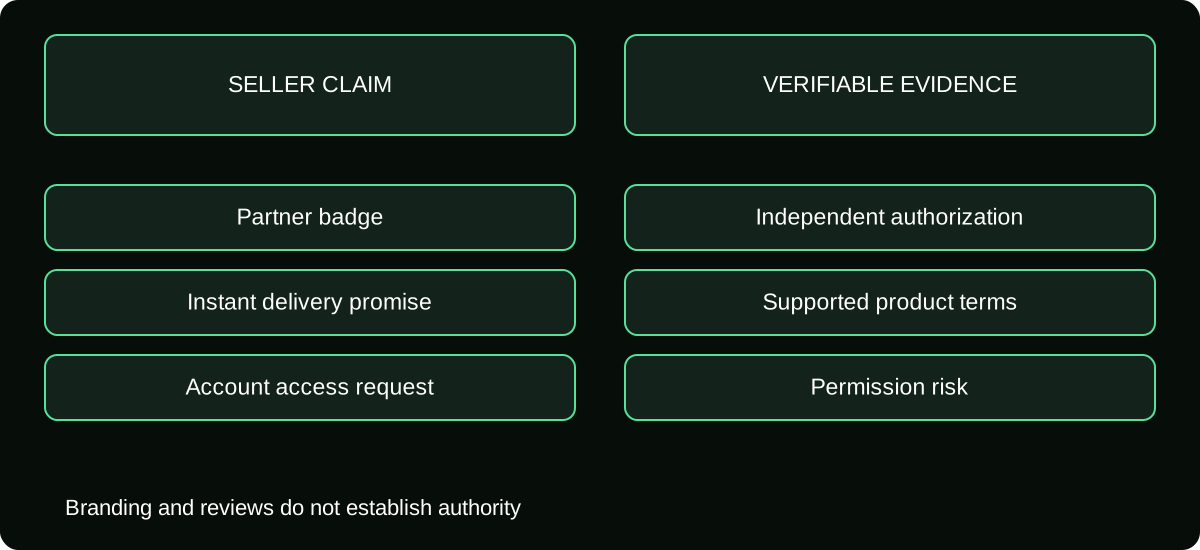
For a gift card, inspect redemption and seller conditions. For a claimed direct Coin service, look for actual platform authorization rather than accepting the seller's own badge. A legitimate retail identity does not automatically establish authority to perform every service it advertises.
Read the real destination, not the displayed branding
Enter the official TikTok recharge address independently where supported. If an offer sends you elsewhere, establish why that destination is involved and what product is being sold there.
Read the browser's actual hostname. A string such as tiktok.com.example.invalid places the familiar words before a different host; it is not the same as tiktok.com. This is an explanatory non-live example, not a site to test.
A padlock, certificate, copied logo, or professional layout does not prove merchant authorization. Those features can make a page look credible while the underlying delivery claim remains unverified.
Examine the required access
A seller asking for your TikTok password, login code, device approval, or remote control is asking for access, not merely a public recipient label. Read each request by what it permits.
If the seller says access is necessary to obtain a lower price or bypass a restriction, do not treat that as authorization from TikTok. It can expose account recovery, creator data, and payout settings as well as the intended purchase.
Do not upload a store receipt or card image containing unnecessary details to prove you are a “real customer.” Legitimate dispute evidence belongs in an appropriate private process, not an open-ended request from an unverified counterparty.
Distinguish a card product from a loaded account
A supported gift card has product-specific conditions and an official redemption destination. Verify the issuer and permitted market, preserve the receipt, and keep the PIN private.
A loaded account is different: someone is offering account credentials with a claimed balance. That does not establish a supported transfer of Coins or stable control of the account. The original owner or an attacker may retain recovery access.
Similarly, a promise to send unused Coins directly from another viewer's wallet should not be assumed supported. TikTok's virtual-item terms govern allowed use; a seller's private description cannot create a transfer mechanism the platform does not provide.
Review the payment request and merchant evidence
| Question | Evidence worth checking | Weak substitute |
|---|---|---|
| Who takes payment? | Identifiable merchant and actual payment record | A payment logo in a screenshot |
| What is delivered? | Specific product and written terms | “Instant recharge, all regions” |
| How is it redeemed? | Supported official route | A private activation message |
| What happens on failure? | Applicable seller and provider process | Guaranteed refund promise in chat |
Payment methods have different protections and dispute conditions. Do not assume an invoice or a familiar wallet makes every purchase recoverable. Inspect the actual transaction type and recipient before approval.
Be alert when the seller insists on a method that is difficult to reverse and refuses basic product details. That combination deserves investigation before payment, not a larger test purchase.
Do not let social proof replace authority
Reviews, follower counts, transaction screenshots, and a long account history can be copied, manipulated, or unrelated to the specific product. They may inform a broader assessment, but none proves a supported Coin-delivery arrangement.
Ask whether the claimed authorization can be verified independently from the relevant platform or issuer. A badge designed by the seller is not independent evidence. If you cannot confirm a material claim, leave it unconfirmed rather than inventing trust from appearance.
Do not pressure yourself to conclude that every unknown seller is criminal. You can simply decline an offer whose product, terms, and delivery you cannot verify. Your decision does not require making a public accusation.
Understand the limits of a successful test order
A small delivery can show that something arrived once. It does not prove the source of funds was legitimate, future orders will be fulfilled, or the arrangement complies with the platform's rules.
Increasing the payment because a first order worked can create a larger exposure without resolving those unknowns. The same applies to a seller who shows another customer's completed balance: you do not know the full transaction or later outcome.
Verification should therefore precede payment where possible. A test is not a substitute for understanding the product, receiving route, required access, and provider terms.
Make a clear go-or-stop decision
Proceed only through a route you can identify and whose relevant terms fit the intended account. Stop when access demands, unsupported product claims, incompatible region conditions, or unclear merchant identity remain unresolved.
If you already disclosed information or paid, switch from evaluating a seller to containing the exposure. Preserve the offer, payment reference, and messages. Contact the actual payment provider and secure any affected accounts.
Do not accept a second fee to fix the first purchase or hand over more credentials to obtain a refund. The right evidence is an official credit or a documented remedy through the relevant party, not escalating promises from the person whose original claim remains unverified.
Preserve the offer before asking about a dispute
Save the product page and terms as they appeared when you considered or made the purchase. Include the actual destination and merchant identity, not only a cropped promise from a chat. A seller can later change a page or describe a different product.
This is particularly useful when a claimed Coin recharge turns out to be a card code, service fee, or account rental. The dispute needs to establish what was offered and paid for. Do not accept a renamed product after delivery as proof that the original promise was fulfilled.
Frequently asked questions
What if the invoice names a different product from the advertised recharge?
Resolve that mismatch before paying. Keep the original offer and do not assume a generic service invoice proves that the seller will deliver the specific Coin product you intended to purchase.
Can I trust a seller endorsed by a creator?
An endorsement does not establish issuer authorization or payment protection. The same product, access, and delivery checks still apply.
What if the seller becomes angry when I ask for terms?
You do not need to complete a purchase whose essential conditions remain unclear. Avoid further disclosure and preserve any relevant evidence if a payment or access issue already exists.
Sources and scope
- TikTok Virtual Items Policy — rest-of-world scope stated on the page
- TikTok Help — Gifts, purchase routes and supported gift-card redemption
- TikTok Newsroom — Security Checkup controls
- U.S. FTC — what to do if you were scammed