
Viewers use Coins to activate Gifts; TikTok records creator recognition and rewards separately, including Diamonds. The official material reviewed does not establish one universal Coin-to-Diamond-to-cash formula for every account, market, and program.
TikTok Help — Diamonds and LIVE rewards.
Coins do not enter the creator’s wallet as a direct transfer
A viewer's Coin balance falls when a supported action is activated. The creator's account can record Gift activity and recognition under TikTok's own system. These events should not be described as moving the same digital asset between two personal wallets.
That distinction is more than wording. It means you cannot infer the creator's withdrawable amount by copying the viewer's Coin total. The platform's terms, relevant reward rules, and account records govern later stages.
When you read that a Gift “converts,” ask what evidence the author means: a Coin charge, a Diamond observation, an estimated reward, or a completed payout. A precise-sounding ratio is not useful unless its units and scope are explicit.
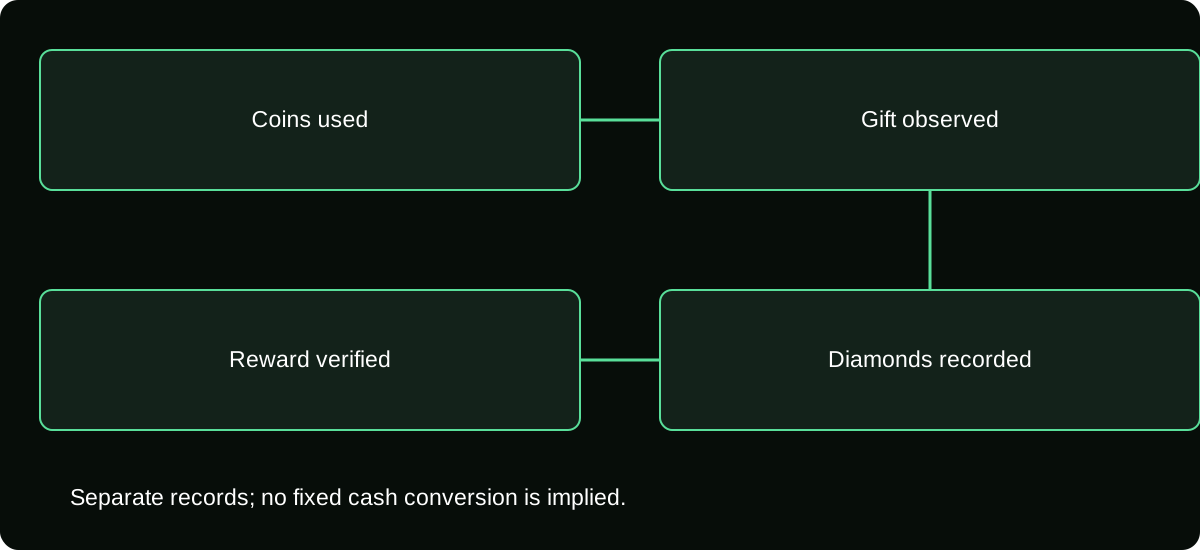
Identify the evidence at each stage
| Stage | Source to inspect | Unit |
|---|---|---|
| Viewer activates a Gift | Current Gift charge and viewer activity | Coins |
| Gift appears for a creator | Own session or account activity | Gift type or count |
| Recognition is recorded | Creator's relevant account record | Diamonds or stated metric |
| Reward becomes payable | Applicable program and payout screen | Stated reward currency or amount |
| Money is received | Payment provider or bank | Actual payment currency |
Do not replace missing records with a web calculator. A useful audit preserves uncertainty where a stage is not available instead of silently assigning a conventional rate.
TikTok's Diamonds help describes their role in recognizing creator contributions and explains where creators can view the relevant balance. It is not a public retail exchange-price list for viewers' Coins.
Why a single Diamond delta can mislead
Suppose you observe the creator balance before and after a LIVE. The difference may reflect several events or a different reporting period. TikTok's help also describes recognition connected with missions or campaigns, so the delta should not automatically be attributed to one Gift.
Check the date range, posting status, relevant session, and any documented adjustments. A number captured during the LIVE and another captured after processing may describe different stages rather than a stable conversion.
If you cannot isolate Gift-related activity, label the observation as a total account change. That is still useful evidence; it simply does not prove a per-Gift formula. Good reconciliation sometimes ends with an unresolved component that requires official clarification.
Build a matched observation without inventing a rate
For your own eligible creator account, preserve the session identifier, visible Gift activity, starting and ending relevant records, reporting window, and any campaign or adjustment entries. Use the platform's labels exactly so you do not turn a metric into money by renaming it.
If a viewer voluntarily supplies purchase-use evidence, use a redacted record of the particular Gift action, not their full billing history. You do not need a sender's password or payment details to understand a public interaction.
Compare only matched events and periods. If the platform does not provide the granularity needed, state that the observed data cannot support the calculation. A blank or unavailable result is more accurate than selecting a common internet ratio just to fill a table.
Keep recognition ratios separate from payout calculations
Even if you can describe a relationship between a recorded Gift measure and a Diamond change for one observation, it does not automatically determine the reward payment. A second relationship may govern payable rewards, and the payout provider can introduce another stage.
For that reason, a chain such as “Coins times assumed Diamond ratio times assumed dollar value” compounds uncertainty. The final decimal places can look exact while neither assumption is established for the account.
Use the actual payable amount for earnings records and actual receipt for cash-flow records. Treat a Diamond observation as recognition data unless the applicable program gives a verified monetary interpretation for that specific task.
Evaluate third-party conversion claims critically
Look for the source date, account market, program, and whether the author distinguishes documented policy from user reports. A ratio copied by many websites is still not an official guarantee.
Be especially cautious when a technical-looking data field is presented as proof of a universal exchange rate. A field label or event count can describe platform activity without establishing a legal entitlement to payment. Ask how it was matched to the creator's actual reward and payout records.
You can use a calculator as a clearly labelled scenario tool, but do not publish its output as confirmed earnings unless the inputs and interpretation are verified. Scenario arithmetic is not firsthand payout evidence.
Resolve a mismatch with the right question
If Gift activity appears but recognition seems absent, report the session and relevant records. If recognition appears but no reward is available, ask about eligibility and program treatment. If a payable reward exists but funds did not arrive, investigate the payout.
These are three different support tasks. A viewer recharge receipt cannot resolve a creator payout error, and a payment-provider transaction cannot explain a missing session metric.
Use the creator account's private help route and retain the case reference. Describe the labels and quantities you can actually see. Avoid demanding correction to an assumed ratio that the platform has not promised.
Make responsible estimates when exact data is unavailable
For planning, use ranges or scenario inputs only when they are clearly identified as your assumptions. Do not tell a viewer that sending a specific Coin quantity will guarantee a specific creator reward.
For accounting, prefer the account's reward statements and payments over hypothetical conversions. Keep the date and status because an estimate and a completed payment can belong to different periods.
The practical takeaway is to follow the units and evidence through the system. Coins explain viewer use; Gift records explain the interaction; Diamonds describe a creator metric; payout records explain money. A reliable explanation keeps those roles separate rather than forcing them into one unsupported exchange rate.
Frequently asked questions
Can my Diamond count fall after I record it?
Inspect the applicable terms and any account adjustment notice. A screenshot captures a moment, not a guarantee that an estimated or reviewed balance can never change.
What if a session crosses midnight in my reporting timezone?
Preserve its actual start, end, and the platform’s reporting definition before comparing balances. A split reporting day can prevent a simple before-and-after observation from isolating one session’s recognition.
Can a screenshot of another creator’s balance validate my conversion?
It does not supply the matching period, program, or events for your account. You can discuss it as a limited observation only with proper context and permission, not as proof of your entitlement.
Sources and scope
- TikTok Help — Diamonds and LIVE rewards
- TikTok Virtual Items Policy — United States
- TikTok Virtual Items Policy — rest-of-world scope stated on the page